

Same-day access to a commercial dethatcher rental for landscapers depends on local stock and whether pickup or delivery fits your job schedule. Check availability early, then compare the rental period and machine size with the work you need to complete. A wasted trip or undersized machine costs billable time.
When a job is already scheduled, you need a quick, reliable equipment plan. A nearby rental is useful only if the machine is ready when you need it and you can get it to the site. This guide covers how to check same-day availability, compare daily and weekly rental costs, choose a suitable machine width, and plan pickup or delivery. It also explains which job details affect your choice, so you can coordinate equipment and crew schedules while avoiding preventable delays.
Key Takeaways
- Plan pickup or delivery around the machine’s weight, transport setup, and job-site access to avoid losing time on rental day.
- Match cutting width and machine type to the site and workload, not just the fastest option available.
- For same-day rentals, check local stock early and confirm the equipment and accessories you need before setting your crew’s schedule.
- Compare daily and weekly rates against the time the job will actually take, then choose the rental period that keeps equipment costs in line.
Do rental companies deliver dethatchers or do I need to pick one up?
Delivery can save a crew trip, while pickup gives you control over transport. Compare the delivery charge with the time, vehicle, and loading plan needed for pickup.
Delivery Fees and Equipment Pickup
Include that charge in the job estimate, along with travel time and site access. Pickup avoids the delivery fee, but requires a suitable vehicle and safe loading plan. Confirm that your transport setup can handle loading, securing, and unloading the machine.
Whichever option you choose, coordinate the equipment handoff with the crew’s arrival and work sequence. A late delivery can leave workers waiting, and an impractical pickup can create the same bottleneck.
Rental Requirements and Coverage
Treat the deposit as a separate cash-flow item, not part of the rental charge. Review the rental agreement for identification, payment, damage responsibility, insurance terms, and return conditions. The agreement defines the coverage details, so understand what your business policy covers before accepting responsibility for rented equipment.
Rental terms and delivery options depend on the agreement and equipment handoff. Review the terms before building the machine into your job schedule.
Renting suits a defined job that requires a dethatcher for a limited time. Buying means taking on ownership, storage, and ongoing maintenance. Hiring a lawn-care service shifts the work to a provider, while renting leaves operation to your crew.
Before operating a dethatcher, review its manual and safety decals. Wear the manufacturer-recommended protective equipment, including eye protection and gloves. Inspect the work area, clear obstacles, and set up the machine according to its instructions. Keep the crew away from the operating path, and stop the machine before adjusting or clearing it. A careful setup helps prevent avoidable interruptions and equipment damage.
Machine size and cutting width
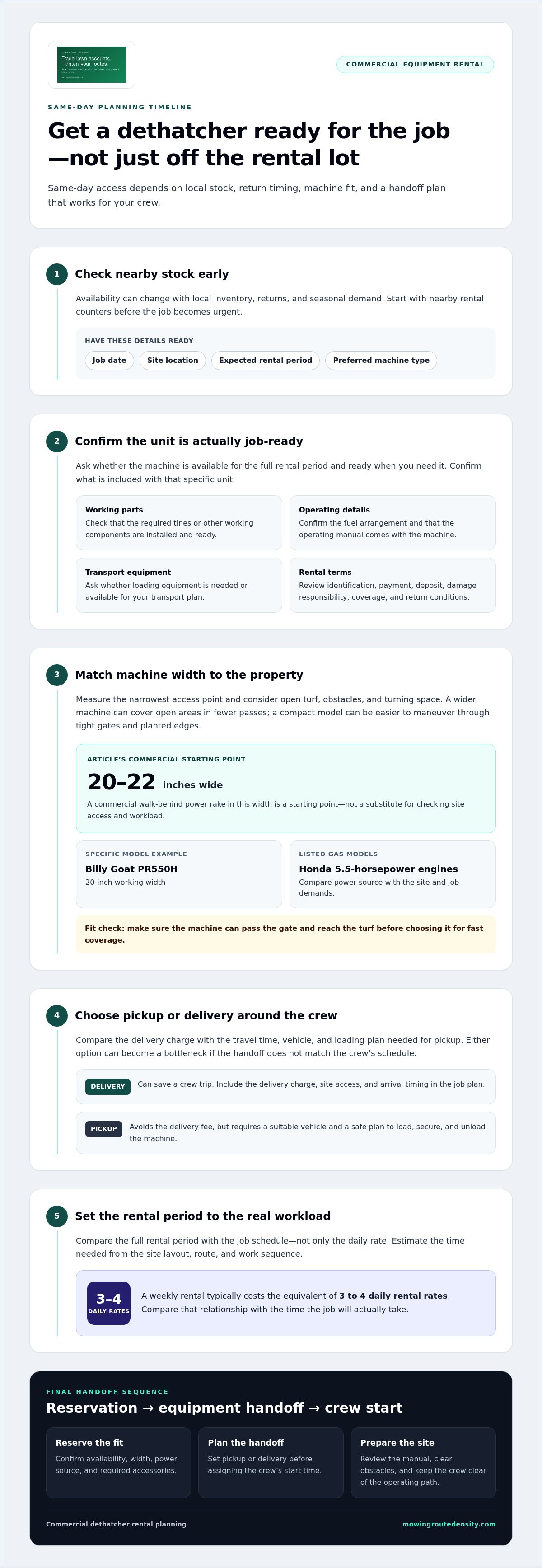
For many professional jobs, start with a commercial walk-behind power rake measuring 20 to 22 inches wide. Listed gas dethatcher models use Honda 5.5-horsepower engines. That combination gives a practical starting point for comparing working width and power source, but the site layout and workload should drive the final choice.
Working width is the strip the machine clears in one pass. A wider machine can cover open turf with fewer passes, but a compact model may be easier to maneuver through tight gates, narrow paths, and planted edges. Map the work area before choosing, noting access points, obstacles, and turning space. An extra-wide deck is no use if it cannot reach the turf.
The Billy Goat PR550H has a 20-inch working width. Use that figure to estimate how the machine fits a route: divide the lawn into manageable lanes, account for overlap, and plan around trees or beds that interrupt straight passes. For example, an open commercial lawn may favor a steady pass pattern, while a segmented property requires more turns and repositioning. Width affects pass planning, not just the machine’s footprint.
For a professional crew, a gas-powered walk-behind model is a sensible starting point when the job requires a commercial machine. The listed dethatcher models’ Honda 5.5-horsepower engines provide a concrete comparison point. Choose an electric option only when its power setup suits the site and the job’s demands; the source facts here establish the available engine specifications, not a universal power-source winner.
Before booking a commercial dethatcher rental for landscapers, compare the machine’s width with the narrowest access point and the largest open area. Consider working width, engine type, and operating instructions together. A machine that handles the open lawn but cannot pass through the gate creates extra work. Choose a size that balances access with efficient coverage so the crew can work across the whole property.
Can I find a dethatcher rental near me the same day?
Same-day rental depends on local inventory, return timing, and whether the machine is ready for the job. Seasonal demand can limit availability during busy dethatching periods, so begin with nearby rental counters and a clear equipment request.
Call early with the work date, site location, and preferred machine type. Ask whether a unit is available for the entire rental period, then arrange pickup or delivery. If your first choice is booked, consider an alternative only if its working width and power source suit the site. A reservation helps coordinate equipment with the crew’s schedule; an unplanned visit can leave workers waiting.
Accessories and setup matter, too. Ask what is included with the specific machine and whether the required tines or other working components are installed and ready. Confirm the fuel arrangement, operating manual, and any loading equipment needed for transport. Make sure the machine’s working width fits through gates and around obstacles. Checking these details helps prevent a second trip for missing equipment or a machine that does not fit the site.
Use a short availability checklist:
- Give the rental counter your job date, location, and expected rental period.
- Name the machine type and working width your site can handle.
- Ask whether the unit is ready, and what accessories and instructions come with it.
- Set the pickup or delivery plan before assigning the crew’s start time.
Seasonal scheduling rewards preparation. During peak demand, start looking before the job becomes urgent and identify a backup machine type. A large lawn may need a longer rental period than a quick stop between appointments. Match the reservation to the crew’s route, site access, and expected work sequence. This helps equipment availability support the schedule rather than dictate it.
Daily and weekly rental costs for commercial gas dethatchers
Compare the full rental period with the job schedule, not just the daily rate.
A weekly rental typically costs the equivalent of 3 to 4 daily rental rates, and weekly dethatcher rates are typically 40-50% less per day than standalone daily rates. That makes the weekly option worth comparing when work spans several days. A lawn larger than half an acre may need a 2 to 3 day rental or a weekly rate. Estimate the work window, then compare both totals before booking.
Machine type also affects the budget. These are different equipment categories, so compare capability as well as rate.
- For a one-day job, compare the daily rate with the expected work window.
- For several consecutive workdays, calculate the weekly rate against daily charges.
- For a larger lawn, plan for a 2 to 3 day rental or compare weekly pricing.
- For specialty equipment, weigh the verticutter or tow-behind rate against the job requirements.
Base the cost estimate on productive use. Crew delays or a rental period that extends beyond the work can outweigh a lower daily rate. Set the job sequence before choosing a rental term, then include transport and any required deposit in the operating plan.
If your route also needs a mower, explore lawn mower rental options as you plan equipment for the work ahead.
Mowing Route Density: lawn mower rental
Mowing Route Density offers lawn mower rental for crews balancing seasonal work and equipment needs. A dethatcher handles a specific turf task, while a mower supports an ongoing route. Plan for each need separately to avoid buying machinery that sits idle between projects.
When route capacity is the bigger concern, Mowing Route Density’s lawn account trading platform lets professionals buy, sell, or swap service routes. Its lawn mowing service provider locator connects customers with mowing companies in their geographic areas. These tools address different needs, so choose the one that fits your next operational decision.
If lawn mower rental fits your equipment plan, visit mowingroutedensity.com to learn more.
Put Your Equipment Plan to Work
Turn the dethatching job into a workable crew plan: assign the machine to a specific site, schedule labor around the equipment, and keep the rest of the route moving. A commercial dethatcher rental for landscapers is one part of that plan. The broader goal is to align equipment and route capacity with the work ahead.
When your operation also needs mowing equipment or route support, Mowing Route Density offers lawn mower rental, a lawn account trading platform, and a lawn mowing service provider locator. Choose the option that fits your next operational decision, whether you need equipment or want to improve route capacity.
Contact Mowing Route Density to explore the tools available for your lawn care operation. Keep the plan practical, protect crew time, and move into the next job with confidence.
Frequently Asked Questions
How much does it cost to rent a dethatcher?
The machine category affects the rate: a verticutter, combo unit, or tow-behind model will have a different rental range. Compare equipment type and rental length together to price the machine that fits the job.
What's the difference between daily and weekly dethatcher rental rates?
Weekly rentals typically cost the equivalent of 3 to 4 daily rental rates, and weekly rates are typically 40-50% less per day than standalone daily pricing. For a job likely to span several workdays, compare the weekly total against the expected daily charges. The useful comparison is the full rental period, including any extra time needed for site access or job sequencing.
Where can landscapers rent commercial dethatchers in the United States?
Landscapers can find commercial dethatchers through equipment rental businesses and rental counters serving their work area. Search by machine type and location, then compare pickup and delivery logistics with the crew’s route. For same-day needs, call with the required machine category, job date, and rental period. Local stock and return timing determine whether a suitable unit is ready.
What types of commercial dethatchers are available to rent?
Common rental options include gas-powered and electric walk-behind power rakes, verticutters, combo units, and tow-behind dethatchers. Manual tine rakes may suit smaller or less equipment-intensive tasks. Choose based on the turf area, site access, and how the machine fits your work plan. A tow-behind unit, for example, requires compatible towing equipment and room to maneuver.
How much does it cost to rent a commercial dethatcher per day, week, or month?
Monthly rental cost depends on the machine category, rental duration, and extension terms. For a longer project, compare the full rental quote with the actual work schedule rather than assuming daily pricing scales evenly across the month.
What should landscapers check when picking up and returning a rented dethatcher?
At pickup, compare the machine’s condition with the rental paperwork and note any existing damage before loading. Check that the working components and accessories match the agreement, and make sure the operator has the manual and safety decals. Before returning the machine, follow the return instructions, remove job debris, and document its condition. This creates a clear record at both handoffs.


